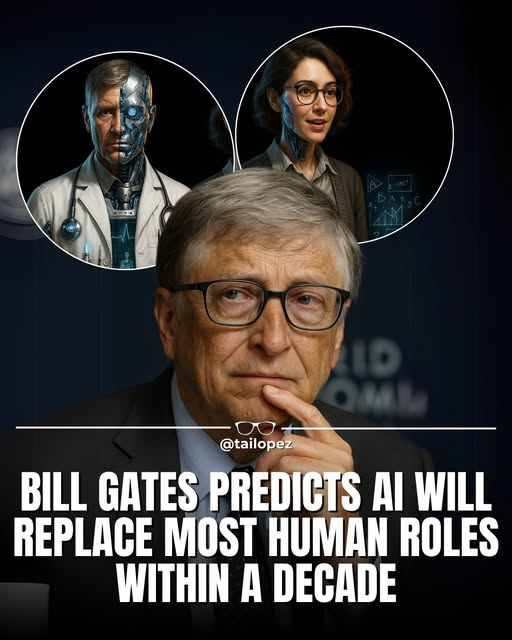
Bill Gates, the co-founder of Microsoft and a longtime advocate for innovation in technology, has made a bold prediction about the future of artificial intelligence. He believes that within the next ten years, AI will replace most human roles across a wide range of industries, including some of the most critical sectors of society — such as healthcare and education. Gates refers to this transformation as the dawn of “free intelligence,” a future where access to expert-level services in medicine and learning is not limited to the privileged few but is available instantly to anyone, anywhere in the world.
According to Gates, artificial intelligence will be capable of taking on the responsibilities of doctors and teachers, providing accurate diagnoses, treatment plans, educational support, and personalized learning experiences at a level equal to or even exceeding that of trained professionals. This is not simply about replacing workers — it is about eliminating global shortages that have long plagued these essential fields. In many developing regions, there is a chronic lack of qualified teachers and doctors. AI, Gates argues, can fill that void by offering scalable, always-available assistance that costs nothing per additional user.
Gates envisions a world where anyone with a smartphone or computer can access a virtual doctor that understands symptoms, reads medical scans, and prescribes treatments with clinical precision. Similarly, students in rural or underserved areas could receive the same quality of education as those in elite institutions, guided by AI tutors that adapt to their individual learning pace and style. This equalization of access to high-level services could mark a turning point in global development, dramatically reducing inequality in healthcare and education.
Beyond these core areas, Gates predicts that artificial intelligence will also revolutionize other labor-intensive sectors, including logistics, manufacturing, and agriculture. Smart AI systems will optimize supply chains, operate autonomous machinery, and manage large-scale food production with unprecedented efficiency. These changes could lead to higher productivity, reduced costs, and more sustainable practices across the global economy.
However, not everyone shares Gates’s enthusiasm. Critics of this vision argue that current AI systems, no matter how advanced, lack the empathy, ethical reasoning, and contextual judgment that are essential in human-centered professions. A doctor’s bedside manner, a teacher’s encouragement, and a social worker’s emotional intelligence cannot be fully replicated by algorithms. There is also concern about over-reliance on technology, job displacement, and the widening of digital divides, particularly in areas where access to reliable internet and modern devices is still limited.
Despite these warnings, Gates remains firmly optimistic. He acknowledges that AI must be guided with care, regulation, and human oversight, but he believes that its potential to solve some of the world’s most pressing challenges is too great to ignore. He points to ongoing breakthroughs in AI-powered drug discovery, climate modeling, and disaster response as evidence that intelligent systems are already making positive contributions to humanity.
In his view, the key lies not in resisting technological change, but in managing it wisely. Governments, tech companies, and educators must work together to build ethical frameworks, retrain workers for new roles, and ensure equitable access to the benefits of AI. Gates emphasizes that AI should be used to enhance human potential, not diminish it. By automating routine tasks and augmenting complex ones, AI can free up people to focus on creativity, innovation, and care — areas where human intuition still shines.
The transition will not be without challenges, but Gates believes that society is capable of adapting. Just as the industrial revolution redefined the labor landscape of its time, so too will the AI revolution reshape the future of work, learning, and living. If handled with foresight and responsibility, this shift could unlock a new era of opportunity, where intelligence is no longer a scarce resource but a freely accessible tool for all.